























A fan engagement strategy is how a club, league or governing body turns attention into repeat participation: fans who predict, vote, play along and share, and who give you data you own as they do. Done well, it grows ticketing, membership and merchandise, and gives your commercial team sponsor assets to sell.
Key takeaways
- Followers aren't a database. Fan engagement campaigns turn social reach into contacts you can market to directly.
- Plan for three groups of fans: casual, engaged and loyal. Each needs a different level of effort to take part.
- Use every moment of the season: before, during and after the match, and all year round.
- Every campaign can carry a sponsor, which turns engagement into revenue.
- Measure new contacts, repeat participation and sponsor results, not just likes.
What is a fan engagement strategy in sport?
Fans have always engaged with their teams. They buy tickets, wear the shirt and argue about selection. What has changed is where that happens. Much of it now takes place on social platforms, which own the relationship with your followers and decide how many of them see your posts.
A fan engagement strategy gives fans reasons to take part on your own channels, in your brand, so that every interaction becomes something you can build on. It covers the digital experiences fans take part in, such as score predictors, tipping competitions, player of the match votes, quizzes, fan photo walls and giveaways. It also covers how you promote them, who each one is for, which sponsor it carries and what happens to the data afterwards.
Why a fan engagement strategy matters commercially
When fans feel part of the club, they build an emotional connection that holds through a tough season. That loyalty shows up at the gate, in the club shop and in renewals. It also gives you honest feedback on what fans like, what they don't and what you could do better.
Engagement is only worth the effort if it moves something the club is measured on. There are two routes, and they feed each other.
It grows a fan database you own
Every entry adds a contact you can reach again, for membership, ticketing and merchandise, whatever the algorithm does. Wests Tigers ran a signed bobblehead giveaway, promoted on organic social only, and half of all entrants were people the club had never had contact with before. It took 25 minutes to build. Read the Wests Tigers bobblehead case study.
It creates sponsor assets you can sell
A campaign with a sponsor's name on it is something your commercial team can put on the rate card. NSW Rugby League ran Macca's Moment of the Match, a McDonald's fan vote across all six 2024 State of Origin matches. That one sponsorship activation delivered about 15% of McDonald's total digital campaign impressions in the Origin period, and about 1,000 new first-party email addresses. See how NSWRL ran its McDonald's fan vote.
Casual, engaged and loyal: plan for three kinds of fan
Not every fan wants the same thing from you. A useful way to plan is to think of three groups, and to give each one an easy reason to move to the next.
| Fan group | Who they are | What works | Where to reach them |
|---|---|---|---|
| Casual | Follow you on social, watch some matches, rarely buy | Quick, low-effort experiences: a one-question poll, a giveaway, a player of the match vote | Social, QR codes at the ground, web links that open instantly |
| Engaged | Attend matches, open your emails, have opinions | Quizzes, a score predictor for a big match, fan photos for the big screen | Email, your website, match day |
| Loyal | Members, season ticket holders, app users | Season-long tipping competitions or prediction leagues with leaderboards, squad predictors, member-only rewards | Your app, member emails, an always-on hub |
Simple campaigns build reach. Deeper ones keep your most committed fans coming back every round. Your official app suits loyal fans, but most casual fans won't download it to enter one competition, so run the same campaign on the web as well. We explain how in why your club app is only half the story.
Fan engagement ideas for every moment of the season
Match day is your biggest engagement point, but you only get so many of them. Spread campaigns across the whole cycle so fans have a reason to come back between matches.
Before the match
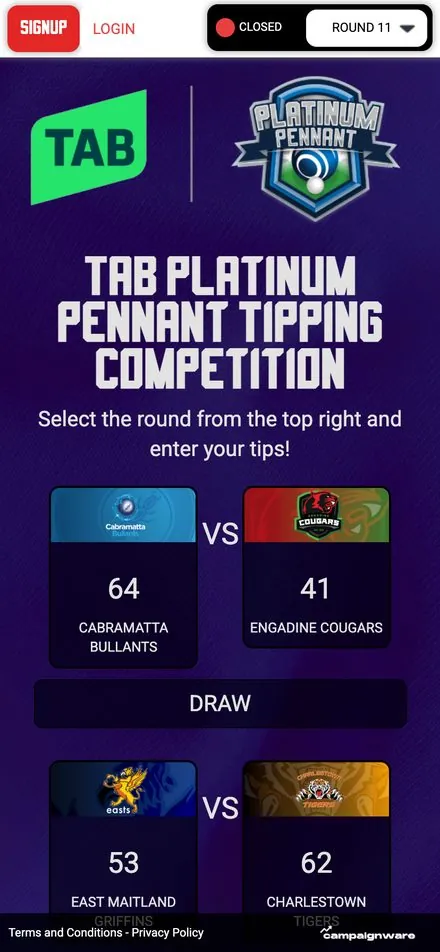
- Score predictor or tipping competition. Fans predict results each round and climb a leaderboard. It's called a tipping competition in Australia and New Zealand, and a score predictor or prediction league in the UK and Europe. See the predict the score template.
- Pick your team. Fans choose their starting line-up before the team is announced, which gives you content and a view of what supporters think.
- Countdown quizzes. A short trivia quiz on the opposition or a club milestone, shared on social in the days before a big match.
During the match
- Fans on the big screen. Fan photos and messages shown in the stadium, reached from a QR code on the screen. Race of Champions Sydney ran four campaigns from one QR code at Accor Stadium and converted 35 to 40% of impressions into hub engagement. Read the Race of Champions case study.
- Live player of the match vote. Open the vote in the closing minutes and announce the winner at full time, with a sponsor's name on it. See the polling and voting template.
- Half-time moments. A quick quiz or spin and win for fans in their seats, with a prize they can collect at the ground.
- Something custom. Hawthorn fans put themselves in the team photo at the MCG with an augmented reality experience built by Campaignware Studio, which builds what templates can't.
After the match
- Moment of the match. Fans vote for the best moment from a shortlist of highlights, and you share the winning clip.
- Follow-up emails. Thank people for taking part, tell them who won and give them a next step, such as a discount code for the club shop.
- Fan content on your channels. Reuse fan photos and comments on social, with permission, so your feed shows real supporters.
All year, including the off-season
- An always-on hub. Omnihub, our hub template that brings several digital experiences together in one branded page, gives fans one destination for every live campaign.
- Awards and fan votes. Team of the decade, goal of the season or greatest kit of all time keep fans involved between seasons.
- Giveaways built on what you already have. Signed merchandise, membership packages, or experiences such as meet and greets, autograph sessions and behind-the-scenes tours.
- Birthday and milestone messages. Use the details fans have given you to send personal messages and exclusive content. People who feel known stay closer to the club.
How to use social media without depending on it
Social is where most fans first see your content, so use it well: post regularly, reply to comments, share fan content and promote your campaigns there. Our guide to five ways sports teams can use social media to build brand awareness covers the basics.
The catch is that reach on social depends on the algorithm, and the network keeps the relationship with your followers. Use social to send people to campaigns that capture data you own. We cover the method in how to take back control of your audience from social media algorithms. The details fans choose to share with you, such as their favourite player or how they watch, are often called zero-party data. Read what zero-party data is and how to collect it.
How to run it with Campaignware
- Pick a template. Choose the mechanic that fits the moment and the fan group: a predictor before the match, a vote during it, a hub for the season. Browse all templates.
- Put it in your brand. Add your logos, colours and fonts, and run it on your website or your own web address. A typical campaign takes 20 to 40 minutes to build, without developers or designers.
- Set prizes and terms. Choose a prize fans value, such as signed merchandise or a money-can't-buy experience, and set clear entry terms.
- Share it everywhere fans are. Promote it on social, show a QR code on the big screen, send it by email and embed it in your app or hub.
- Collect consented data. Every entry adds a contact who has opted in. Data goes into your CRM, automatically where an integration exists.
- Report to your sponsor. Share impressions, unique users, clicks through to the sponsor and completion rates from the platform's reporting.
For a fuller campaign plan, from setting goals to the follow-up email, see 10 steps to a fan engagement campaign that builds loyalty.
How to measure your fan engagement strategy
Likes and views tell you something was seen. These measures tell you whether it worked:
- New contacts. How many entrants were new to your database. Wests Tigers tracked this, which is how it knew half its bobblehead entrants were new to the club.
- Repeat participation. How many fans come back round after round, especially in season-long formats.
- Profile depth. Ask for one more detail in each campaign, such as postcode or date of birth, so profiles get richer without long forms that put people off.
- Sponsor results. Impressions, unique users, clicks through to the sponsor and completion rates, ready for your renewal conversation.
- Commercial outcomes. Membership, ticket and merchandise sales from the contacts your campaigns brought in, tracked in your CRM.
Every subscription includes reporting and analytics in the platform, so you can show sponsors results from your own audience. Read more about building a fan engagement platform for your club.
Frequently asked questions
How do sports teams engage fans online?
Sports teams engage fans online by giving them something to do, not just something to watch. Score predictors, tipping competitions, polls, quizzes, fan photo walls and giveaways invite fans to take part on the club's own channels. Promoted on social and email, and shown on the big screen on match day, each one captures consented data the club can use to stay in touch.
What are good fan engagement ideas for smaller clubs?
Start with what you already have. A giveaway of signed merchandise from the club shop, a player of the match vote or a short quiz on club history costs little to run and appeals to every fan. Promote it on your social channels, ask for an email to enter, and follow up with a thank-you. Wests Tigers built its bobblehead giveaway in 25 minutes.
How do sponsors benefit from fan engagement campaigns?
Sponsors get more than a logo placement. A sponsored campaign puts their brand inside content fans choose to take part in, with clicks through to their website, opt-in leads where you offer dual opt-in, and results they can measure. For NSW Rugby League, one McDonald's fan vote delivered about 15% of the sponsor's total digital campaign impressions during State of Origin.
Do fans need to download an app to take part?
No. Campaignware campaigns run as web pages that open in any mobile browser, from a social post, a QR code or an email link. You can also embed the same campaign in your official app, so loyal fans take part there while casual fans join in from the web. That way you capture data from both groups without asking anyone to install anything.
Related reading: Premier League prediction league: 5 ideas · Wigan Warriors rugby league team selector · Hawks Mega Quiz trivia series
Want to see how this would work for you? Book a demo, or talk through your project with our team.