























Your official app is built for your most loyal fans, but many casual fans will never download it to enter a vote or predictor. The answer is a hybrid approach: run each campaign as a web page anyone can open instantly, and embed the same campaign in your app. You reach every fan and capture data from both groups.
Digital teams at sports clubs can feel they have to choose between driving app downloads and reaching the widest possible audience. In our experience, you don't. This guide shows how to use the web and your app together so you remove friction for casual fans, reward app users and build a stronger marketing funnel.
Key takeaways
- Don't force the download. Use mobile web pages for high-traffic moments like match day, then point that traffic to an app download with a clear call to action.
- Embed for loyalty. Put high-priority campaigns inside your app for your most loyal fans, and make the more accessible ones easy for everyone to reach from your website.
- Bridge the gap. Use the web to show casual fans what the app offers, then give them an app-only reason to install it.
- Prioritise first-party data. On the web or in the app, the email address is your most valuable asset for long-term marketing.
- Test in stadium conditions. A web campaign often loads faster than an app store page in a crowded stadium with limited bandwidth.
The limits of an app-first strategy
Many digital managers are under pressure to prove the value of their club's official app. It makes sense on paper. An app allows push notifications, deeper tracking and a premium experience.
But only a share of your fans will download your app and keep it. If you run your player of the match vote or score predictor only inside the app, you leave out everyone in the stadium or watching at home who doesn't have it.
That isn't a failure of the app. It reflects how people use their phones. In 2017, TechCrunch reported comScore data showing that the majority of US smartphone users downloaded zero apps in a typical month. Asking a casual fan to download an app just to enter a short competition is a high-friction request, and many will simply say no.
The hybrid approach: one campaign, two places
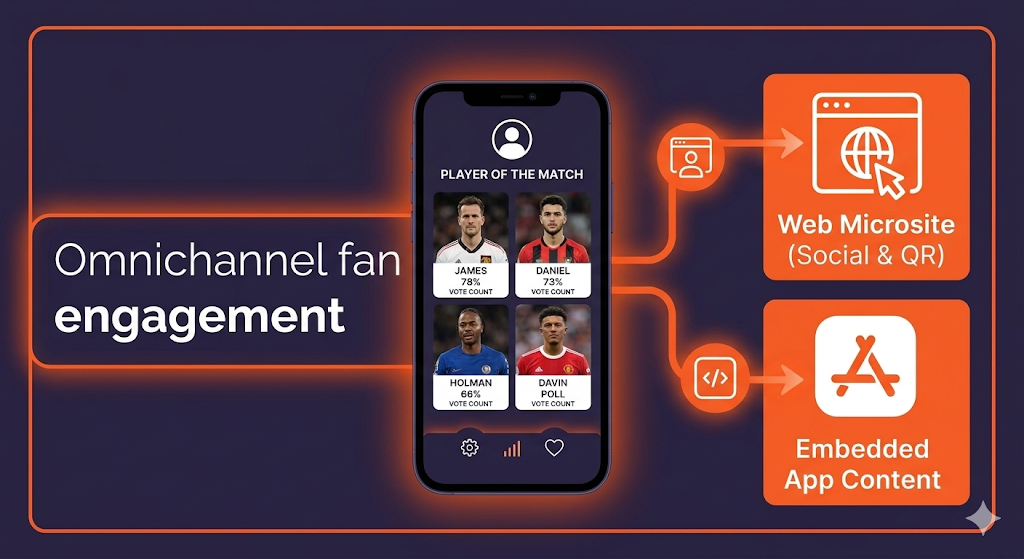
The goal isn't to choose one group over the other. The approach that works is to build each campaign once and run it in two places at the same time.
- As a web page. Launch the campaign on its own link. It suits social media bios, QR codes on stadium screens and email newsletters, and it opens instantly in any mobile browser with no download.
- Embedded in your app. Take the same campaign and embed it in a WebView or a dedicated section of your official app.
Your most loyal fans take part in the app they already use, and you still capture data from the casual fan who just wants to make a quick prediction. No group is left out. You meet every fan where they already are.
Why does app friction slow growth?
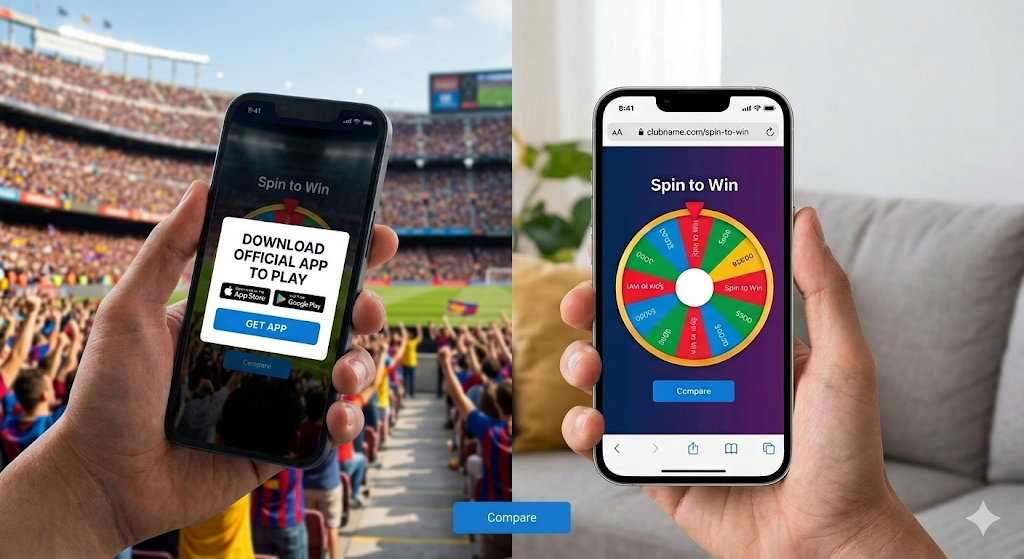
In digital marketing, every extra step reduces your conversion rate. When you send a fan from a social post to an app store, you add a lot of friction. They have to find their password, check their data allowance and wait for the download. If a fan hits a barrier, they move on to the next thing in their feed.
A web page works as the front door to your club. It captures a fan's interest while it's at its peak. Once you have their email address and they've had a good experience, they're far more likely to download your app later, when you suggest it as a premium upgrade.
Reach and depth: what the web and your app each do best
| Web page | Official app | |
|---|---|---|
| Best for | Reach: your widest net, for finding new fans and learning their preferences | Depth: building habit and loyalty |
| Who it reaches | Casual fans, new fans, everyone at the ground | Members, season ticket holders, your most loyal fans |
| Typical campaigns | Match day votes, quizzes, giveaways, big-screen fan photos | Always-on content, season-long predictors, rewards |
| How fans arrive | Social posts, QR codes, email links | Push notifications, the app home screen |
Keep the branding and experience the same in both places, so a fan recognises your club whether they're on your website or in your app.
Three ways clubs use the hybrid approach
- A match day hub. Omnihub, our hub template that brings several digital experiences together in one branded page, gives fans one place for everything on match day. Link to it from a stadium QR code for the general public, and embed the same hub as the match centre in your app. Explore the Omnihub template.
- Sponsorship activations that reach more fans. Sponsors want as many people as possible to see their brand. A web-first sponsorship activation reaches your whole digital audience, not only your app users.
- A soft-sell funnel to the app. Run a trivia quiz on the web to engage the widest audience. On the thank-you screen, link to the app download with an app-only reward. Your engagement campaign becomes a way to win new app users. See the trivia template.
Race of Champions Sydney ran four campaigns from one hub, reached by a QR code on the screens at Accor Stadium, and converted 35 to 40% of impressions into hub engagement, with no app download needed. Read the Race of Champions case study.
How to run it with Campaignware
- Pick a template for the moment, such as a vote, quiz, predictor or hub. Browse all templates.
- Put it in your brand, with your logos, colours and fonts, on your website or your own web address.
- Set prizes and terms, including any app-only rewards.
- Share the web link and embed it in your app. Use social, QR codes and email for the web version, and a WebView for the app.
- Collect consented data from every entry, wherever it comes from. Data goes into your CRM, automatically where an integration exists.
- Report to your sponsor with the platform's reporting on impressions, unique users and clicks through to the sponsor.
How to measure success across channels
With a hybrid approach, your reporting becomes more complete. You're no longer only counting app opens. You can track:
- Participation by channel. How many people took part on the web, and how many inside the app?
- Data volume. Are you collecting more first-party data now that a download isn't required to take part?
- App acquisition. How many people downloaded the app after taking part in a web campaign? Campaign Link creates a short link, QR code and UTM tag in one step, so you can see where each download came from.
- Fan sentiment. Are casual fans happier now they can join in without technical hurdles?
Your official app is a vital part of your digital mix, but it shouldn't be a walled garden that keeps most of your fans outside. For more ways to reach every kind of fan, read our complete fan engagement guide for sports marketing.
Frequently asked questions
Should sports clubs run campaigns in their app or on the web?
Both, where you can. The app is best for your most loyal fans, who already use it, while the web reaches casual fans who won't download an app to take part in one campaign. Building the campaign once and running it in both places means you capture data from everyone, and you can use the web version to encourage app downloads.
Can you embed a Campaignware campaign in a club app?
Yes. Campaignware campaigns can run on their own web address, be embedded in your website, or sit inside your official app in a WebView or a dedicated section. It's the same campaign in each place, so you build it once and fans get the same experience in your club's branding wherever they take part.
How do you get fans to download the club app?
Give them a reason after they've already had a good experience with you. Run a campaign on the web first, capture their email, then offer an app-only reward on the thank-you screen or in your follow-up email. Fans who know what the app offers are far more likely to install it than fans who are asked to download it before they can take part.
Do web campaigns work in stadiums with poor reception?
A short web campaign usually asks much less of a connection than downloading an app from an app store, which matters when thousands of people share the same network. Test your campaign at the ground before match day, keep the entry form short, and show the QR code on the big screen long enough for fans to scan it.
Read more about Campaignware for clubs, leagues and governing bodies.
Related reading: Hawks Mega Quiz trivia series
Want to see how this would work for you? Book a demo, or talk through your project with our team.


