























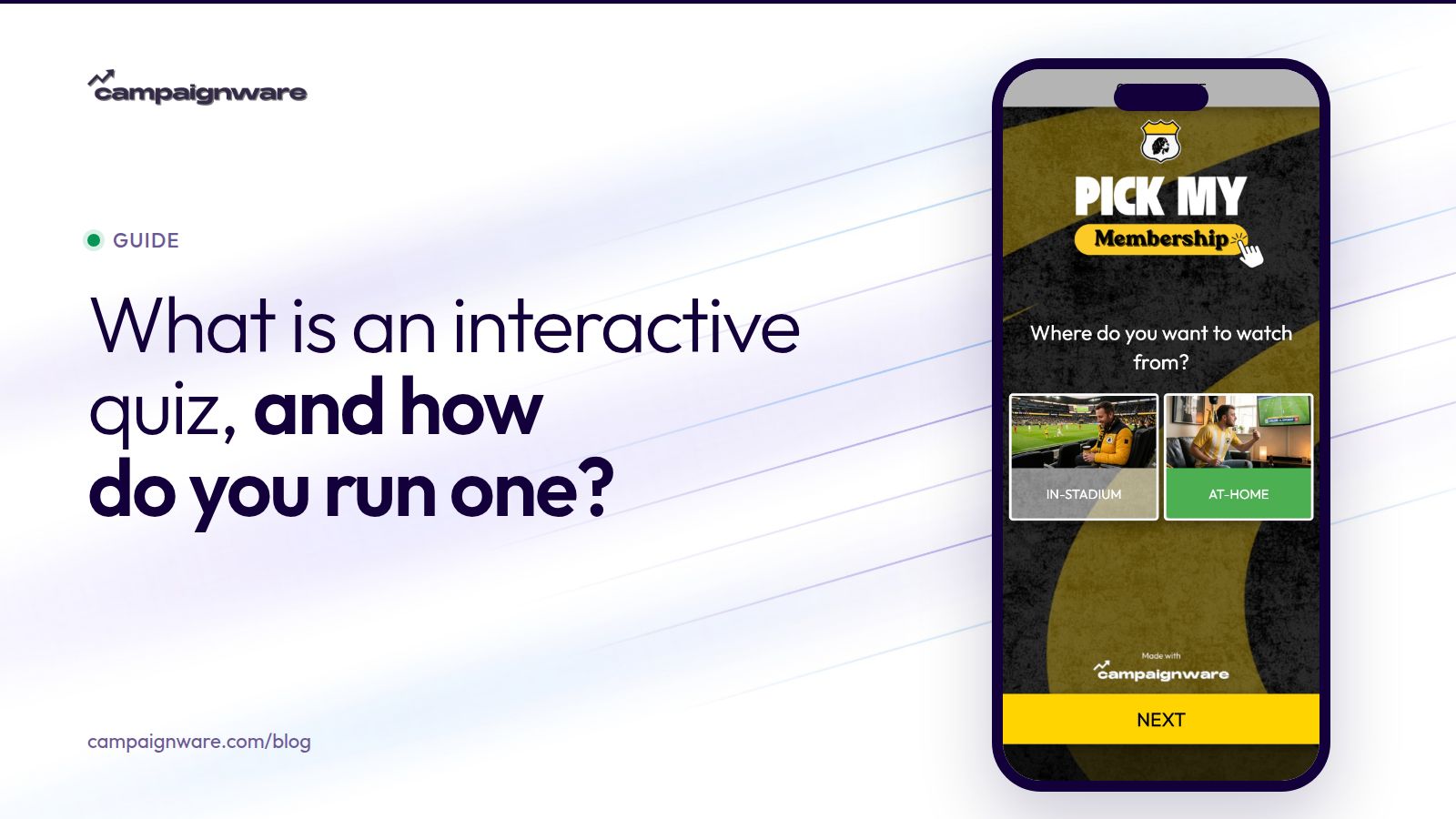
An interactive quiz is a set of questions people answer online to get a result that is personal to them, such as a score, a ranking or a recommendation. For marketers, it's one of the simplest ways to turn attention into engagement and consented data: people enjoy taking part, and every entry adds a contact you can reach again.
Key takeaways
- An interactive quiz gives each person a result: a score, a place on a leaderboard or a recommendation.
- Quizzes hold attention better than a static form, so more people finish.
- Add a data capture step before the result, and every entry becomes a contact you own.
- Trivia, personality and product finder quizzes are the most common types.
What is an interactive quiz?
An interactive quiz is content that people respond to, rather than just read. Each answer feeds into a result that is unique to them, worked out by the software as they go. That might be a score out of ten, a place on a leaderboard or the product that suits them best.
What are the main features of an interactive quiz?
The main features are simple, and vary a little with the type of quiz:
- Questions and answers: multiple choice, image choices or typed answers.
- Timers: a time limit per question adds a little pressure and makes it more fun.
- A result: a score, a personality type or a recommendation, shown at the end.
- A leaderboard: for trivia run across a match, an event or a season.
- A data capture form: details, consent and terms, collected before the result.
What types of interactive quiz are there?
- Trivia quiz: tests what people know, often with a leaderboard and a prize for the top scores.
- Personality quiz: “Which player are you?” or “What's your travel style?”, with a shareable result.
- Product finder quiz: a few questions that recommend the right product, often with an offer at the end.
- Knowledge quiz: helps staff, resellers or customers learn about a product or topic.
Why use interactive quizzes in your marketing?
1. Higher engagement
When people have fun, they pay more attention. Compared with a standard Google or Microsoft Form, a quiz adds timers and a score, which makes taking part more enjoyable. More people finish instead of abandoning a flat survey, and with higher engagement come richer results about what your audience knows and wants.
2. Better recall
Quizzes help people remember. Research on students found that quizzes improve academic performance. In marketing, the sense of achievement people feel when they finish can help your brand, products and messages stick.
3. Motivation to finish
People like a tangible result for their effort. A score or a personal recommendation at the end gives them a reason to answer every question.
4. A better relationship with your audience
Phone calls and repeated emails asking for opinions can feel like a chore. A quiz asks for the same insight in a way people enjoy, so they come away with a better impression of your brand and a reason to take part again.
5. Data at scale, without the admin
Scoring is automatic, so you see results as they come in rather than processing answers by hand. Every entry adds consented data, and the data goes into your CRM, ready for your next campaign.
Interactive quiz examples
- Half-time trivia at a football match. Grimsby Town FC ran a branded half-time trivia quiz when it hosted Brentford FC in the Carabao Cup, and supporters the club had no data on before opted in to hear from it. Read the Grimsby Town FC case study.
- A farewell quiz for a club legend. Hawthorn FC built a trivia quiz on Shaun Burgoyne's career for his final matches, with questions about his disposals, kicks and team number. It's one of the campaigns in our best of footy 2021 roundup.
- A quiz series in the club app. Hawthorn also ran a ten-episode trivia series through the Hawks app, with a membership for the top scorer at the end. See the Hawks mega quiz episodes.
- A product finder for a brand. A skincare or sports brand asks four questions and recommends a product, with a discount code at the end. (An idea to try.)
- Sponsor trivia. A club runs a weekly quiz in its sponsor's branding, with a sponsor prize and dual opt-in so the sponsor collects leads too. (An idea to try.)
How to create an interactive quiz with Campaignware
Step 1: Set your goal and pick a template
Decide what you want from the quiz: customer insight, new leads, product learning or simply something fun for your next event. That tells you which quiz to pick and what to measure. Then choose your template in the campaign builder, such as the trivia template for a knowledge quiz with a leaderboard, or browse all campaign templates.

Step 2: Put it in your brand
Upload your logo, background images and videos, and set your fonts and colours. Preview how it looks on mobile and tablet before you go further, so it works for everyone who takes part.

Step 3: Write your introduction and questions
Give the quiz a title and a short introduction that says what people get for taking part, such as a prize or a personal result. Then enter your questions and answer options. Depending on the template, answers can range from short text to picking an image.


Step 4: Set up data capture and your confirmation screen
If lead generation is a goal, this is the most important step. Choose the fields people fill in to get their result or enter the prize draw, and add your terms and conditions, links and any custom fields. Then write the confirmation screen people see after they enter, with options to share the quiz.


Step 5: Set your publishing preferences and share
Set the start and end times, and add your own marketing scripts, such as Google Analytics or Meta, to track every visit. Then save, and embed the quiz in your website or app, or share the link on social, by email or with a QR code.


Step 6: Collect data and report the results
Watch the results in the platform's reporting, including impressions, unique users and completion rates, and send every new contact to your CRM. A typical campaign takes 20 to 40 minutes to build, and most campaigns go live in under an hour. See how clubs, leagues and governing bodies use quizzes on our fan engagement platform page.
Frequently asked questions
What is an interactive quiz used for?
An interactive quiz is used to engage an audience and learn about them at the same time. Brands use quizzes to recommend products and grow their database, sports clubs use trivia to engage fans on match day and across the season, and teams use knowledge quizzes for training. Every entry can capture consented data for future marketing.
How do you create an interactive quiz?
Set your goal, pick a quiz template and add your branding. Write a short introduction and your questions, set up a data capture form with your terms, then choose when it goes live. Finally, embed it on your website or app, or share the link on social, by email or with a QR code, and track the results.
What makes a good quiz for lead generation?
A good lead generation quiz is short, fun and worth finishing. Keep it to a handful of questions, offer a result or prize people want, and ask for details just before the result, with clear consent. Then follow up quickly with something useful, such as an offer linked to their answers, so the new contact turns into a customer.
How long does it take to build an interactive quiz?
With a template, a typical campaign takes 20 to 40 minutes to build, and most campaigns go live in under an hour. The longest part is usually writing good questions. If you need a format no template covers, Campaignware Studio can build it, faster than you'd expect.
Want to see a quiz built in your brand? Book a demo, or talk through your project.


