

















By Adam Mussa, Founder, CEO and Head of Product
We'll start by saying: we're big fans of vibe coding.
AI tools can now turn a few sentences into a working app, and that's a big deal for marketing, partnership and digital teams at clubs, brands and agencies. It's the next step from the no-code solutions we helped to pioneer almost 10 years ago.
So it's fair to ask: why use a platform when you could build your own competition, quiz or fan hub this afternoon?
This guide is our honest take. It covers where vibe coding shines, what changes when real people's data is involved, and how to decide whether to build it yourself.
"I'm a huge fan of vibe coding. I'm not a developer, so I use it myself to build my own personal projects and ideas to test what it can really do. It's remarkable what someone can make in a day with the right prompts and some patience."
Adam Mussa, Founder, CEO and Head of Product, Campaignware
What is vibe coding?
Vibe coding is building software by describing what you want to an AI tool in plain language, then accepting and refining the code it writes, often without reading that code closely.
It's fast, it's accessible, and it puts real building power in the hands of people who have never written code.
Where it shines
Vibe coding with tools like Lovable and Base44 (or even Codex or Claude Code) is excellent for:
- Prototypes. A clickable version of an idea to show your boss or a sponsor.
- Internal tools. Something only your team uses, with no public data.
- Learning what you want. Building a rough version is a quick way to find out what the real thing needs.
- Side projects. The best way to learn what these tools can do is to build something with them.
If that's the job, go for it.
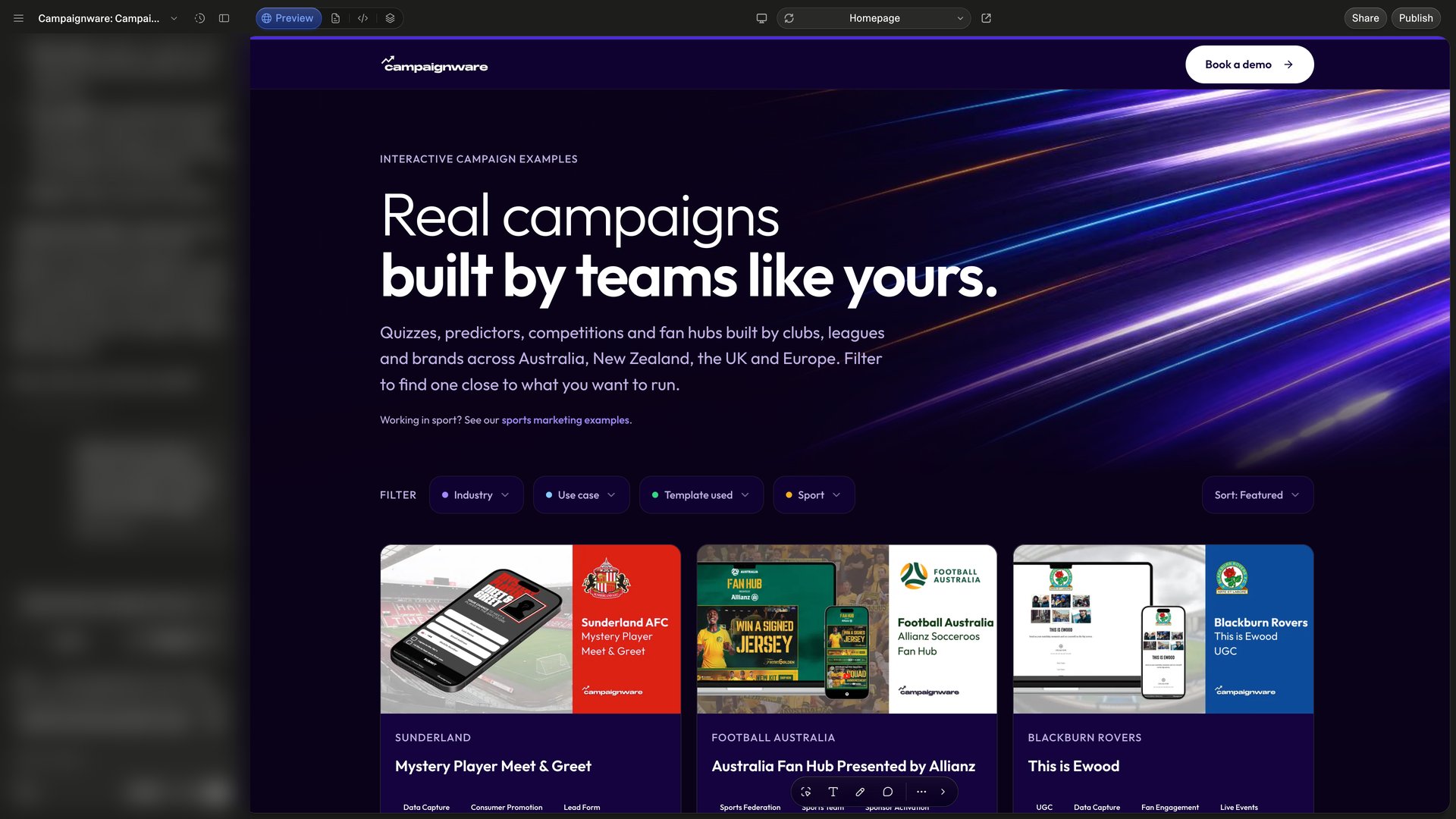
We practise what we preach. Our Showcase, where we share real campaigns from our clients, is built on Lovable. It's an easy way for us to build, deploy and keep improving a site like this, and it's also a test of what these tools can really do, as part of Campaignware Labs, our internal innovation process.
The plumbing question
Think of it like your local hardware store.
Everything you need to do your own plumbing is right there on the shelf, and plenty of people do a great job of it.
But should you, if you don't know how the pipes behind the wall work?
For a leaky tap in your own kitchen, probably yes. For the pipes in a building full of other people, you'd want a plumber who knows what they're doing, because the cost of getting it wrong doesn't land on you alone, and it will cost much more in the long run for them to come in and fix your mistakes.
A public campaign is the building full of people. They enter, hand over their names, emails and phone numbers, and trust that their details are safe.
"What makes me uncomfortable is the idea that you can press one or two buttons labelled 'security' and expect it to be safe. If people are trusting you with their personal information, and you have an obligation to protect it, you need to understand why it's secure, not just that a button said it was. Is it worth the risk when you could face fines and legal ramifications? I'm not so sure."
Adam Mussa, Founder, CEO and Head of Product, Campaignware
What a pro checks that the tools won't tell you
None of this is a reason not to use AI. It's a list of what someone who knows the pipes would check before letting the public in.
Security you can explain
AI-written code is often fine and sometimes isn't. Veracode's 2025 GenAI Code Security Report tested more than 100 AI models on 80 coding tasks and found security flaws in 45% of cases.
The catch is knowing which case you're in.
Security checks built into the tools help, but only so far. In 2025, a security researcher found more than 170 apps built with one AI app builder that let anyone read their users' data, because the database access rules weren't set up properly.
The builder's first security scan checked whether those rules existed, not whether they worked.
Consent and privacy
A campaign that collects data needs clear consent, a marketing opt-in, and data handled in line with GDPR in the UK and Europe and the privacy and spam laws in Australia and New Zealand.
An AI tool will happily build the form.
It won't tell you whether your opt-in wording would stand up to a complaint.
Match day traffic
Campaigns don't get steady traffic. They get thousands of people in the same few minutes: when the QR code goes up on the big screen, when the email lands, at halftime.
Something that works for five testers needs to be built and tested for that moment.
Someone on call
When something breaks during a match or an hour after a launch, someone has to fix it.
If that's whoever wrote the prompt, they now have a second job.
The time it takes to get right
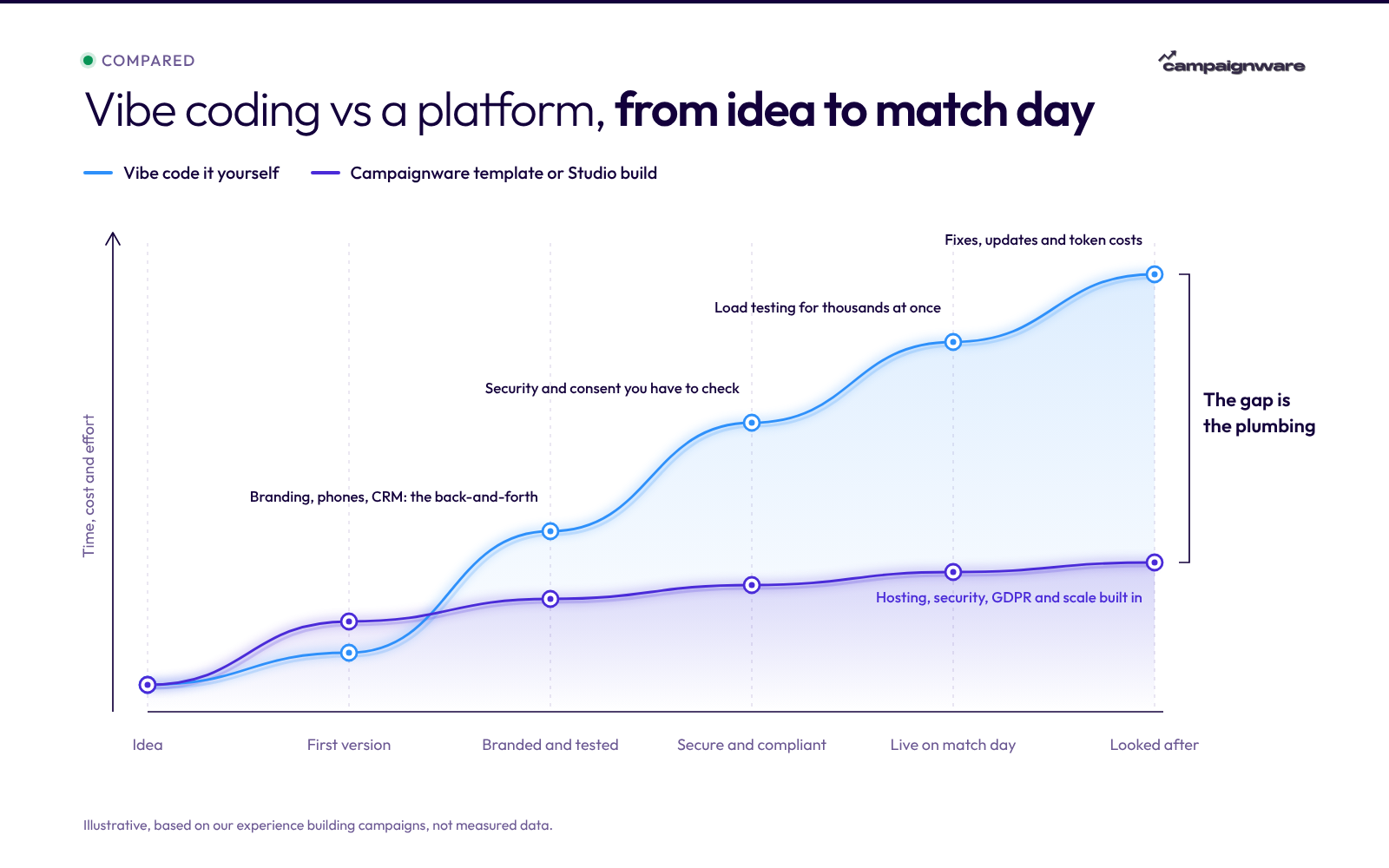
The first version arrives fast. Getting it right takes much longer.
There's the back-and-forth on layout for every phone, your branding, your CRM connection, the edge cases and accessibility. And plenty of teams end up handing the prototype to an agency or developer to finish, which brings back the cost and timeline they were hoping to avoid.
The truth is, it will take you between 3 and 10 times as long to vibe code something to a high standard as it would to use a well-sorted self-service platform.
Is the opportunity cost worth it? That's for you to decide.
Token usage, and sunk-cost fallacies
It's natural to want to keep pushing on once you're on a roll, but it can get expensive, especially in token usage if you're constantly asking for changes, or need integrations, feeds and other things.
Setting up proper systems to save costs takes even more time
"In my experience, tools like Lovable and Base44 are getting more token hungry, whilst making bigger mistakes, and becoming vaguer in their interpretation of your prompts."
Adam Mussa, Founder, CEO and Head of Product, Campaignware
Many on Reddit seem to think that this could be because those expensive and venture-backed platforms are using cheaper models to cut costs.
Questions to ask before you build it yourself
- Will it collect personal data from the public?
- Could thousands of people use it in the same few minutes?
- Can you explain how the data is protected, in your own words?
- Does the data need to reach your CRM or email platform?
- Who will fix it at 8pm on match day or launch day?
- How many hours of your team's time is it worth?
If you answered yes to the first two and weren't sure about the rest, that's the building full of people. Bring in someone who knows the pipes.
Or use "the plumber" and save time and money in the long run
Most campaigns don't need a custom build at all. Tools like Campaignware have templates for the mechanics teams run most: competitions, quizzes, predictors, polls and votes, and Omnihub, our hub template that brings several digital experiences together in one branded page.

A typical campaign takes 20 to 40 minutes to build, and most campaigns go live in under an hour, in your brand, without developers or designers.
Templates come with the parts you'd otherwise take on yourself: hosting, security, GDPR compliance and keeping it running when thousands of people arrive at once. Data is encrypted in transit and at rest.
Some ideas need something custom. That's what Campaignware Studio is for. Studio builds custom digital experiences: bespoke campaigns, microsites, landing pages, minigames and custom integrations, in your brand. Bring us the idea that doesn't fit a template. We'll build it in days.
Studio is built on our platform, so most of the work is already done before we start. That's why it's usually faster and more cost-effective than a fully custom build.
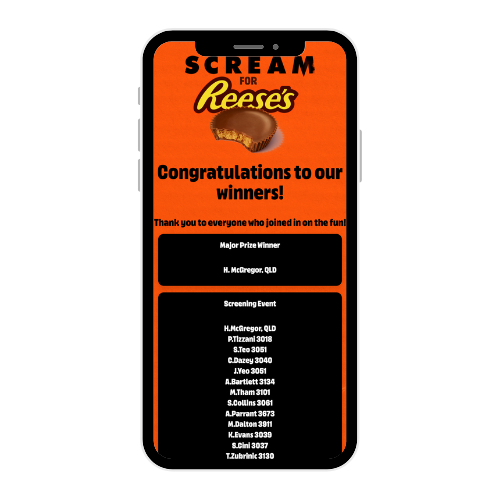
When Reese's (The Hershey Company) and the agency Bastion ran a national spin and win campaign with receipt upload across Coles and Woolworths, about 70% was built on the existing platform and 30% was customised by Studio. Read the Reese's case study.
We've seen this decision first-hand. Several clients have weighed up building their own and chosen Studio instead, because it was simply more convenient: one brief, one team, and no app to look after afterwards.
In conclusion
When the idea is ready to meet the public and collect their details, make sure someone who knows the pipes has checked them.
Have an idea that doesn't fit a template? Brief us on a project and we'll price it to your brief. Or book a demo to see what the templates can already do. See Campaignware Studio and browse the templates.


